


Page 37 - 2022-Mag_88-4
P. 37
Classroom Practice/Program


        Starting Projects

            Genealogy is based on questioning—seeking answers to queries that are
        sometimes easy and other times more difficult. These questions usually occur in
        a sequence, as one answer can lead to the next question. The number of questions
        to each aspect of the project will depend on the age and curricular level of the
        students. Terms used with students should be age- and grade- appropriate. Initially,
        try for easy questions that will, hopefully, generate success as students seek
        answers. For purposes here, questions are grouped into “sets”—questions that
        go together, leading logically from one to the next. As students locate answers,
        ask them to start a folder, notebook, or journal to document these answers.
            Also, advise students that it is fine not to be able to find answers to queries.
        It is just as important to document what research has been unsuccessful
        as it is to document successful results. This saves duplication of effort
        and can often point the researcher in a whole new and more profitable
        direction. A resource that is not productive for one student may be very
        useful for another. Encourage students to share information on their resource
        processes. Helping others solve a problem can help develop respect.

        Curricular Sets
            The following curricular sets are offered as suggestions for
        engaging students. As noted repeatedly, work should be tailored to
        grade levels. Sets 1 and 2 are appropriate for the elementary level;
        Sets 3-6 involve more depth for middle and high school students.
            Set 1: What is your full name?  Do you have a birth certificate, baptism
        card, or other documentation with your full name? Is your full name different
        from what people call you—your nickname? Where do you live? Where were
        you born? Where have you lived between when you were born and now? How
        old are you? What is your birth date? Do you have any pictures of yourself?
            Caution: These questions may be sensitive topics for
        children who are homeless, undocumented, or adopted.
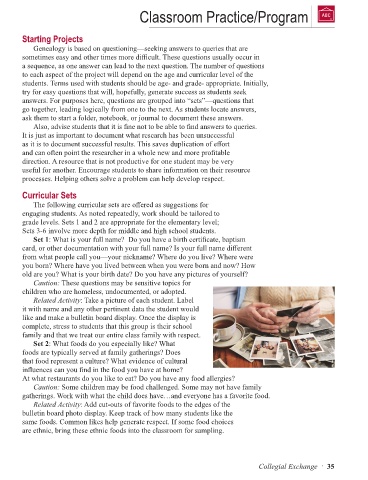
            Related Activity: Take a picture of each student. Label
        it with name and any other pertinent data the student would
        like and make a bulletin board display. Once the display is
        complete, stress to students that this group is their school
        family and that we treat our entire class family with respect.
            Set 2: What foods do you especially like? What
        foods are typically served at family gatherings? Does
        that food represent a culture? What evidence of cultural
        influences can you find in the food you have at home?
        At what restaurants do you like to eat? Do you have any food allergies?
            Caution: Some children may be food challenged. Some may not have family
        gatherings. Work with what the child does have…and everyone has a favorite food.
            Related Activity: Add cut-outs of favorite foods to the edges of the
        bulletin board photo display. Keep track of how many students like the
        same foods. Common likes help generate respect. If some food choices
        are ethnic, bring these ethnic foods into the classroom for sampling.


                                                                                     Collegial Exchange  ·  35

